

LEARN – What technologies are used in asteroid exploration missions?
LEARN – What technologies are used in asteroid exploration missions? https://asteroidday-uploads.s3.eu-central-1.amazonaws.com/wp-content/uploads/2026/02/02085225/Design-sans-titre-2.png 1600 1347 Asteroid Day https://asteroidday-uploads.s3.eu-central-1.amazonaws.com/wp-content/uploads/2026/02/02085225/Design-sans-titre-2.png
Learning Objective:
To describe the technologies used in asteroid exploration missions.
Overview:
Missions to asteroids have progressed from simple flybys to complex operations with autonomous navigation, high-precision sensors, and sample collection. These advances let us study asteroid origins, test planetary defence approaches, and prepare for future activities on small bodies in the Solar System.
Specifics:
Asteroid exploration demands advanced technologies because these bodies have near-nonexistent gravity, hostile environments, and unpredictable rotational movements. Sending astronauts also presents high risks and extreme costs, and today’s technology is still insufficient for controlled manned landings. Therefore, robotic probes and autonomous systems are essential for these missions.
In the 1990s, before dedicated missions, the Galileo probe (NASA) launched in 1989 towards Jupiter performed flybys of the asteroids Gaspra (1991) and Ida (1993). It employed CCD cameras, infrared and ultraviolet spectrometers, and radio tracking to determine mass and composition, carrying out the first detailed studies of these bodies.
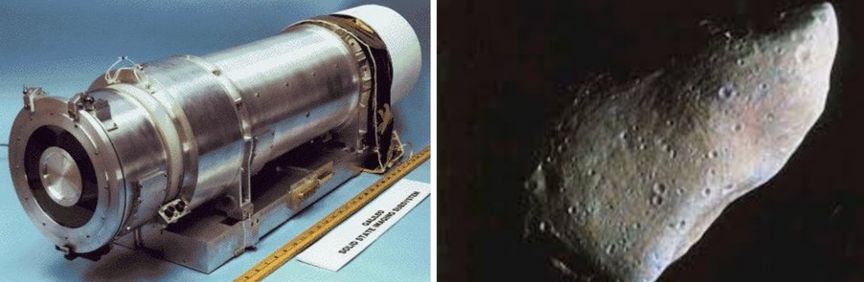
Subtitle: The Solid-state imager – SSI (left) was one of the instruments installed on the Galileo probe, allowing it to obtain close-up images of an asteroid for the first time. (NASA/JPL)
Subsequently, the NEAR Shoemaker mission (1996) orbited and landed on the asteroid Eros using chemical propulsion, optical navigation, and instruments such as spectrometers and a laser altimeter, becoming the first mission to land on an asteroid in 2001.
In the 2000s, the Rosetta mission (ESA, 2004) passed by the asteroids Steins (2008) and Lutetia (2010) before reaching comet 67P/Churyumov–Gerasimenko, using OSIRIS cameras, high-efficiency solar panels, and advanced spectrometers. In the same decade, Japan launched Hayabusa (2003), innovating with ion propulsion, autonomous surface reconnaissance navigation, and an experimental collection mechanism. Its return in 2010 brought back the first confirmed grains from an asteroid.
The 2010s expanded capabilities. Dawn (NASA, 2010) improved ion engines to orbit Vesta and Ceres. In 2014, Hayabusa2 (JAXA) used LIDAR sensors, high-resolution cameras, and explosive charges to access subsurface material on the asteroid Ryugu. In parallel, OSIRIS-REx (NASA, 2016) applied artificial intelligence for navigation and the TAGSAM touch-collection mechanism, returning samples from Bennu in 2023.
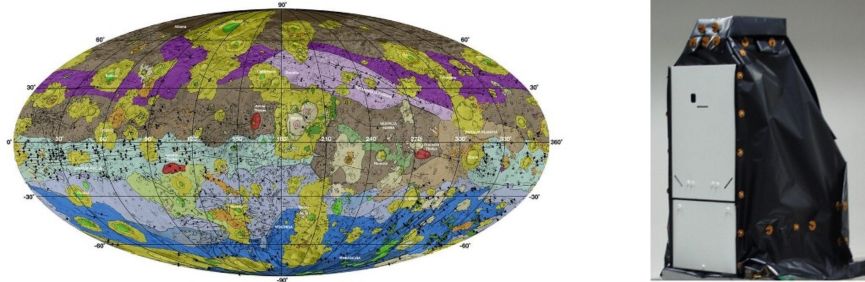
Subtitle: The geological mapping of asteroid Vesta (left) was only possible thanks to the Framing Camera installed on the Dawn probe (right) (NASA – Dawn Mission / I. Szemerey – Research Gate)
In the 2020s, technologies focused on planetary experimentation and defence emerged. The DART mission (NASA, 2021) became the first real attempt to deflect an asteroid by intentionally colliding with the object Dimorphos. It used the autonomous navigation system DRACO (Didymos Reconnaissance and Asteroid Camera for Optical navigation) to guide itself during the impact without human intervention, and had the support of the Italian CubeSat LICIACube, which recorded the effects of the collision.
During this period, other missions also expanded objectives. Lucy (2021) initiated the study of Jupiter’s Trojan asteroids using thermal imagers and AI navigation, while Psyche (NASA, 2023) introduced experimental laser communication and advanced electric propulsion to explore a metallic asteroid.
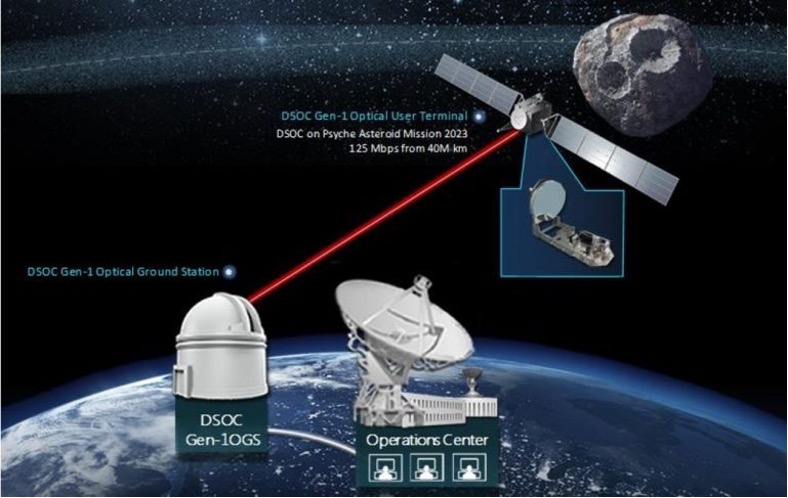
Subtitle: Operation diagram of Deep Space Optical Communications (DSOC), one of the technologies implemented in the Psyche mission for transmitting large amounts of data over long distances. (Psyche mission / Civils Daily)
The evolution of these technologies not only broadened scientific knowledge but also paved the way for space mining, planetary defence, and future robotic operations on smaller bodies in the Solar System.
Learn more about this subject by visiting these websites:
LEARN – How Do We Explore Asteroids?
LEARN – How Do We Collect Samples from an Asteroid?
Why will Hera Explore an Asteroid that was Previously Impacted by DART?
