

When Science Meets Performance and Becomes Embodied Astronomy
When Science Meets Performance and Becomes Embodied Astronomy https://asteroidday-uploads.s3.eu-central-1.amazonaws.com/wp-content/uploads/2026/01/21121354/Cristina-Negucioiu-1-scaled.jpg 1920 2560 Asteroid Day https://asteroidday-uploads.s3.eu-central-1.amazonaws.com/wp-content/uploads/2026/01/21121354/Cristina-Negucioiu-1-scaled.jpg
Before equations and instruments, there is often a moment of quiet astonishment. In this interview, performing artist Cristina Negucioiu traces the origins of Alquimia Estelar, a work that brings astronomical science into the realm of embodied experience. Her starting point was not a laboratory, but an encounter with meteorites in the Atacama Desert, objects that collapse billions of years of cosmic history into something that can be held in the hand. From that moment, performance became a way to explore where scientific knowledge meets emotion, memory and imagination, and how extraterrestrial matter can invite us to reflect on our own place in the universe.

Timelapse Milky Way
Cristina, could you tell us what first drew you to bring astronomical science and performance together in this piece?
I am a performing artist, so performance is my medium of artistic expression. What first drew me to bring astronomical science and performance together was my encounter with meteorites, and the realisation that performance could become a space where the human body meets extraterrestrial matter, bridging the past and the future into an eternal now.
My interest in astronomical science is closely linked to my fascination with the cosmos and the otherworldly. I was first drawn to meteorites because they are the only extraterrestrial matter we can physically touch, and this awakens a deep emotion within me: the fact that we can directly connect with something that comes from outer space.
As I began to immerse myself more deeply in this theme, I discovered a poetic sensitivity within the scientific information related to the particular group of meteorites we are working with: chondrites. They are the first solid formations from the very beginning of the Solar System. With the naked eye, one can see supernova stardust inside them. They are frozen time, having travelled through interplanetary space before falling into the Atacama Desert, one of the world’s most desolate landscapes. There, they remained for hundreds of thousands of years. Jérôme Gattacceca from CEREGE in France dated the terrestrial age of the meteorites found in the Atacama Desert at around 700,000 years, before they were eventually discovered by Rodrigo Martínez, founder and director of the Museo del Meteorito in San Pedro de Atacama.
For me, these meteorites are precious in a deeply symbolic sense. They are connected to our own humanity, as it took them 4.5 billion years to become… us: conscious beings who love, wonder, empathise and cry. I understand them as ancestors. This is the core idea of Alquimia Estelar: to facilitate an encounter with our cosmic ancestors, to take a moment to connect with their stories, which are also our stories. When we look at the sky, we are looking back into our own past.
Astronomical science is not only a mind-expander; it also touches the soul. Outer space is the vastness that holds us. It is the realm we float within, the ultimate mystery concealing the dizzying unknown. Humanity’s fascination with the cosmos is as old as humanity itself; ancient mythologies and modern science resonate with one another. I feel there is an inner, unconscious “knowing” that spans across time. In my understanding, this is the invisible thread that connects us to the universe, that makes us feel awe when we look at the starry night sky and wonder what might lie beyond what we can see.
Alquimia Estelar aims to tune audiences into this state of wonder. As a multidisciplinary performance, it uses different artistic media – film, dance, interactive performance, sound and text – to shape an emotional cosmic encounter, where science becomes poetry and data becomes an embodied experience.
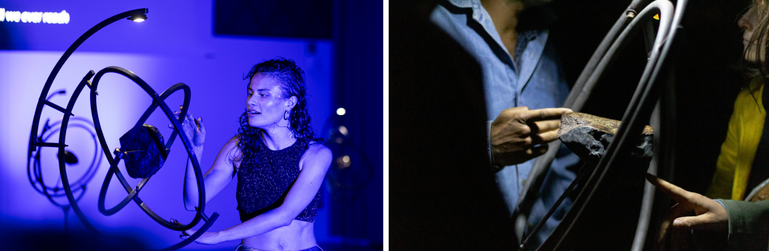
1- Photo credits : Silvia Steinbach , Eduardo Seymour
Asteroid Day focuses on raising awareness of asteroids and planetary defence. In your view, how does Alquimia Estelar connect with this focus?
Alquimia Estelar connects with Asteroid Day’s focus by addressing another essential layer of our relationship with asteroids: their symbolic, emotional and existential dimension.
I see our missions as complementary. Together, they embrace the full spectrum of the complexity of asteroids: celestial objects that are storytellers of cosmic genesis, but also potential threats to our planet. Asteroids have contributed to Earth’s evolution into a life-supporting environment, while simultaneously holding the power to cause mass destruction. I am drawn to this metaphor of asteroids as both creators and possible destroyers.
This paradox inevitably leads me to reflect on humanity itself. Like asteroids, we carry within us multiple potentialities: the capacity to create and to destroy, both existing in latent form.
I also believe our missions converge in raising awareness of asteroids as meaningful celestial bodies with which we are deeply connected, even if we are not always conscious of that connection. By engaging audiences emotionally, Alquimia Estelar can spark curiosity and fascination towards asteroids. From there, interest can naturally open the door to scientific understanding, including planetary defence.
Creating an emotional connection is often the first step towards awareness. The channel Alquimia Estelar uses – embodiment, poetry and multisensory experience – is particularly effective in this regard.
Finally, recent discoveries of interstellar objects passing through our Solar System are further expanding public fascination with asteroids. In this sense, it feels as though the universe itself is amplifying our shared focus at this moment in time.
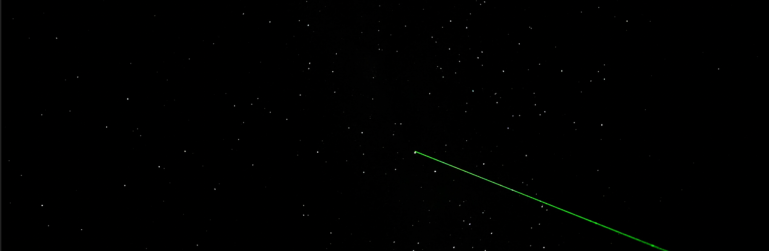
A star field crossed by a green laser beam, capturing the tools we use to observe and understand the night sky.
Alquimia Estelar brings astronomical science and art together, and it began with your visit to the Museo del Meteorito in San Pedro de Atacama in 2023. Could you tell us how that encounter grew into the performance as it exists today?
The project went through a long development phase, beginning with my visit to the Museo del Meteorito in San Pedro de Atacama in November 2023, when the seed of Alquimia Estelar was planted, and culminating in its premiere in April 2025. I was in the Atacama Desert for an art residency (LaWayaka Current) and, as part of my research, visited the museum.
At that time, I did not know much about meteorites, but the idea of celestial objects immediately fascinated me. The museum offers both a scientific audio guide and an interactive section where visitors learn how meteorites are found in the desert and can even touch one. I was guided through this experience by Rodrigo Martínez, the museum’s founder, a renowned meteorite hunter with over 40 years of experience and a collection of more than 6,000 pieces.
Our meeting sparked a collaboration. Rodrigo appreciated my enthusiasm for exploring meteorites through an artistic and emotional lens, and I proposed that we create a performance project together. The timing was perfect, as he was in the process of designing interactive supports that would allow audiences to view meteorites from all angles. Although he is not an artist, Rodrigo is highly creative and enjoys designing material objects. I am drawn to conceptual work, and our respective qualities naturally complemented one another.
As it exists today, Alquimia Estelar has three components: a film, a dance performance and an interactive moment with six meteorites selected and prepared by Rodrigo from his private collection, which have never been exhibited before. This format emerged from the desire to share the complexity of meteorites as fully as possible.
The film was shot in the Atacama Desert, in the area with the highest concentration of meteorites, where Rodrigo took me. It portrays the desert not only as the terrestrial home of meteorites, but also as a gateway to the cosmos, home to the world’s largest telescopes (VLT and ELT), and as a place rich in mystery and mythology. Dramaturgically, it opens the performative experience, tuning the audience into another time and space, closer to the cosmic dimension. Being in the middle of the desert, far from civilisation, with no phone connection, only bare earth beneath my feet and an endless sky above, was profoundly moving. I hope the audience can glimpse something of that experience through the film.
For the dance performance, I translated the scientific information about meteorites that I learned from Rodrigo into movement textures and bodily landscapes, seeking to access a kind of cosmic memory that may still be held in our atoms.
During the interactive part, the audience is invited into the performance space to connect directly with the meteorites. This dissolves boundaries between performer and spectator, human and object, terrestrial and extraterrestrial, symbolising our shared cosmic ancestry.
Although I conceived the overall artistic vision, Alquimia Estelar has been a co-creation. Rodrigo and I brought together his decades of meteorite expertise and my artistic perspective, united by a shared desire to open this fascinating world to wider audiences.
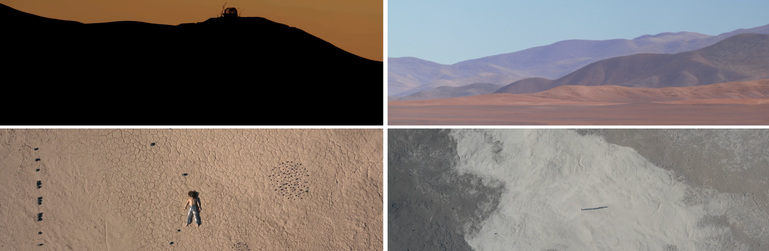
Scenes from the Atacama Desert, vast landscapes where meteorites rest, and where Alquimia Estelar began to take shape.
The project combines your artistic vision with the scientific and museological expertise of the Museo del Meteorito. How does this collaboration help you keep the scientific side clear and reliable, while still leaving space for poetry and emotion on stage?
If I am more dreamy and drawn towards emotion and poetic imagery, Rodrigo is pragmatic and deeply focused on scientific accuracy. For him, it was essential that the scientific content be one hundred per cent reliable. The texts used in the performance, which carry both scientific and philosophical layers, were probably the aspect we debated most intensely.
I wanted to present scientific knowledge as the “voice of the Universe”, something alive and personal. Finding the right form for this was challenging. After many drafts, when I finally felt satisfied, I sent the texts to Rodrigo to check the scientific facts. He was very precise, focusing solely on correctness. At times, I felt his suggestions made the language too rigid, so we entered a long and meticulous process of negotiation, polishing the texts together until they satisfied us both.
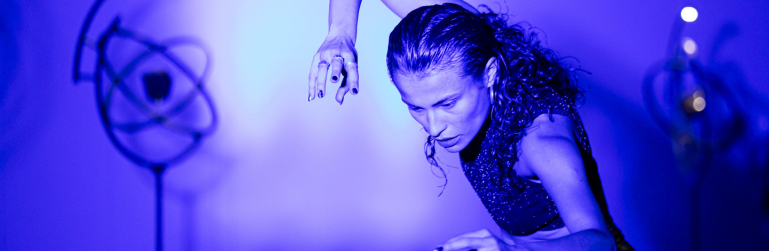
Artiste : Cristina Negucioiu / Photo credits : Silvia Steinbach
Audiences approach space and science with very different backgrounds and sensitivities. What kind of experience do you hope Alquimia Estelar offers to those who encounter it, and is there anything helpful to share in advance so people can engage with the performance more fully?
Alquimia Estelar proposes a performative communication of science rooted in sensitivity and bodily awareness. It addresses a broad audience, from people with no prior familiarity with space-related topics to experts in the field. Based on our experience so far, each person finds something that resonates with them, whether intellectually, emotionally or sensorially.
The piece unfolds in an open, immersive and reflective format that invites contemplation and connection. It allows audiences to engage emotionally with complex subjects such as cosmology, astrophysics and philosophy, presented in a poetic and embodied way. The knowledge it conveys, and the way it is shared, is universal, accessible and non-violent, making the experience suitable for audiences of all ages, cultural backgrounds and levels of prior knowledge.
The project also has an educational dimension, nurturing an embodied understanding of our place in the universe, alongside a cultural dimension that offers international audiences a unique perspective on northern Chile, one of the world’s most important regions for astronomical observation.
To give a sense of the experience, I would like to share a testimonial from Professor Anton Zensus, Director of the Max Planck Institute for Radio Astronomy and Founding Chair of the Event Horizon Telescope:
“It had an uplifting effect, filling the room with a sense of energy, wonder and shared experience that was both rare and remarkable. It was exactly the kind of engagement one hopes for: inclusive, thought-provoking and emotionally resonant.”
In terms of information to share in advance, accessibility is central to the project. The spoken texts are in Spanish, with English subtitles. Blind audience members can engage through tactile interaction with the meteorites and the sound environment, while deaf or hard-of-hearing visitors can experience the dance, film and object interaction. The performance includes many low frequencies whose vibrations can be physically felt, and seating can be adapted accordingly. The meteorite supports are designed at different heights to ensure comfortable access for all visitors, including wheelchair users.
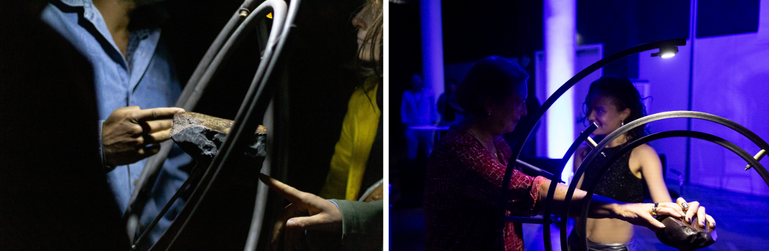
Photo credits : Silvia Steinbach, Eduardo Seymour
Based on the presentations you have already given, what type of space and set-up works best for Alquimia Estelar, and how flexible is it in terms of venue, duration and technical requirements in a festival setting?
We have presented Alquimia Estelar in a range of contexts, both outdoors in San Pedro de Atacama and indoors, most recently in Berlin. From the outset, the project was conceived as itinerant, making it highly adaptable to different venues and formats. In Berlin, for example, it took place in a conference room and worked very well.
The technical set-up is intentionally minimal, consisting of a small number of LED lights to shape the atmosphere, a projector and a sound system. The minimum required performance area is approximately nine metres by five metres, with the audience arranged in a U-shape around the performance space.
The venue should allow for darkness or semi-darkness to support projection and create an immersive atmosphere. We do not require, and in fact prefer to avoid, a raised stage. The audience and performance space should remain on the same level, reinforcing proximity and connection.
Overall, Alquimia Estelar works well in black-box theatres and gallery spaces, but also adapts easily to conference rooms or spacious lobbies, including those within science or interdisciplinary festival settings.
—
At the intersection of astronomy, art and embodied experience, Alquimia Estelar proposes another way of engaging with space science, one that complements analysis with emotion and data with sensation. By inviting audiences to encounter meteorites not only as scientific objects but as carriers of deep time and shared origins, the performance reframes our relationship with the cosmos as something lived as much as understood. In doing so, it reminds us that science does not only expand knowledge, but can also cultivate wonder, reflection and a renewed sense of belonging within the universe we seek to comprehend.
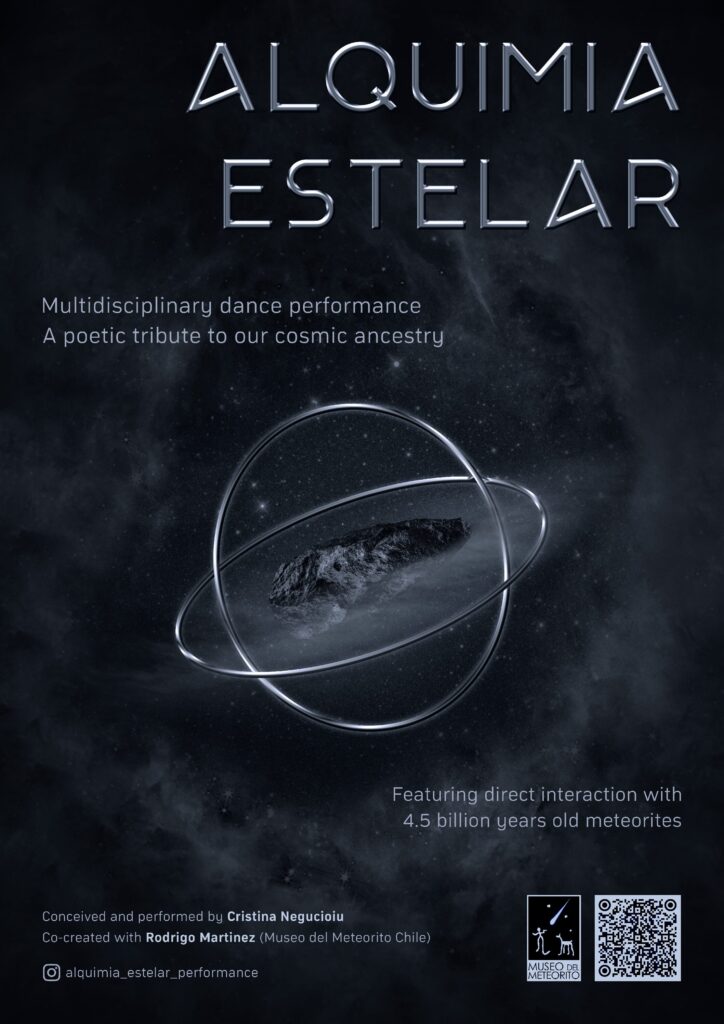
Poster_graphic design – Martina Dybova
